


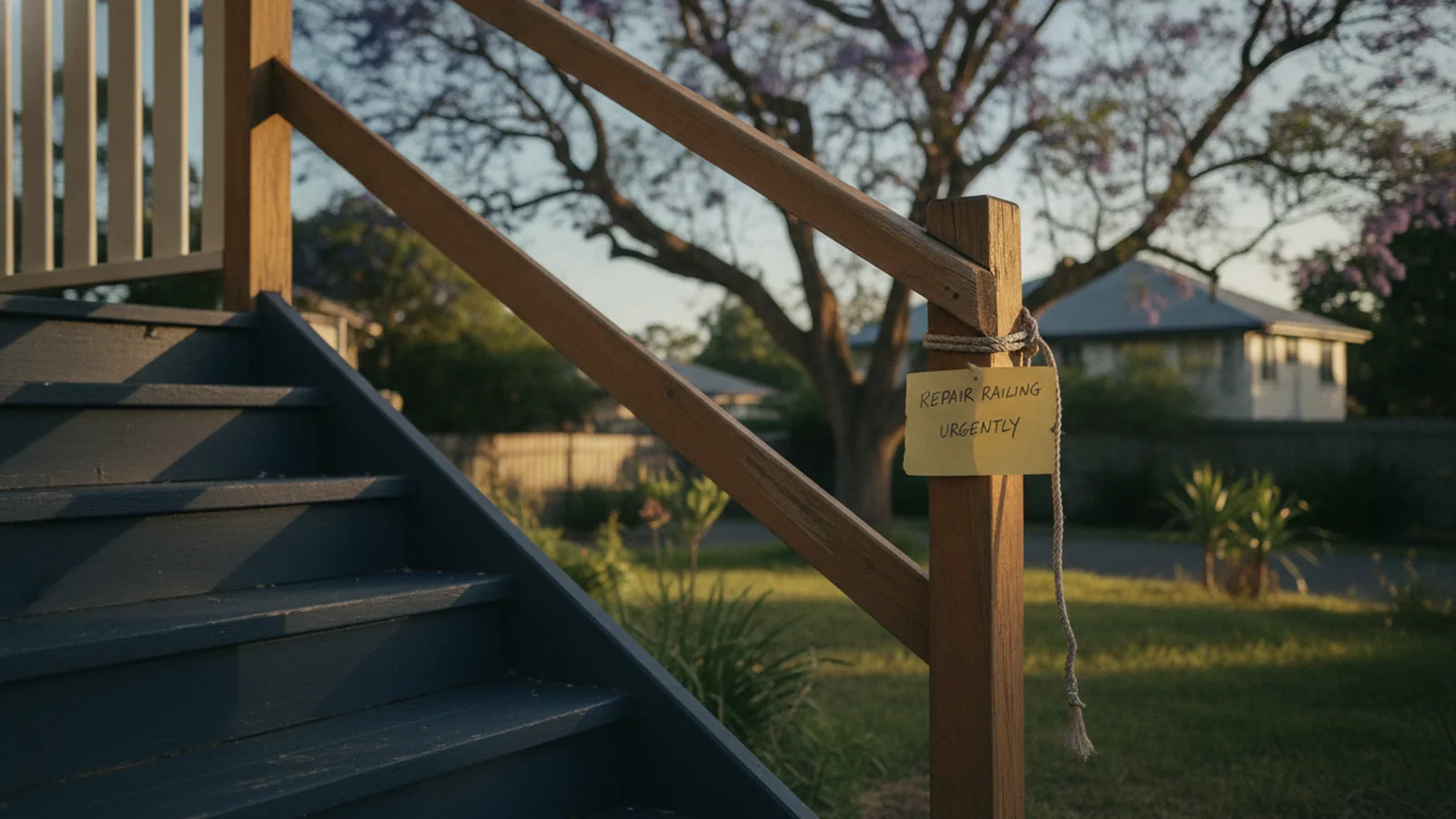
A loose balustrade, a rotten deck board, a broken step, a hot water system that scalds, a roof that leaks onto a tiled floor. Rental properties produce injuries in predictable ways, and the law places clear obligations on the people who own and manage them. Whether an injured tenant or visitor can claim turns on what the landlord knew or should have known, and on who was responsible for the part of the property that failed.
Key points
- Landlords must provide and maintain premises that are clean, safe, in good repair and fit to live in, under the Residential Tenancies and Rooming Accommodation Act.
- A landlord who fails to fix a known defect within a reasonable time, or fails to inspect, can be liable in negligence for injury the defect causes.
- In units and townhouses, common property is the body corporate's responsibility, not the individual landlord's.
The landlord's obligations
Section 185 of the Residential Tenancies and Rooming Accommodation Act requires the lessor to ensure the premises and inclusions are clean, fit for the tenant to live in, and in good repair at the start of the tenancy, and to maintain them that way during it. Queensland's minimum housing standards, which apply to all tenancies, add specific requirements including structural soundness, weatherproofing, functioning locks, and fixtures in good repair. A landlord who ignores repair requests, skips inspections, or lets a known hazard remain has breached those obligations, and that breach is the foundation of a negligence claim when the hazard injures someone.
What has to be shown
The claim is in negligence under the Civil Liability Act. The tenant or visitor must show that the risk was foreseeable and not insignificant, that a reasonable landlord would have taken precautions, and that the failure caused the injury. The evidence is usually documentary: repair requests and the responses to them, entry condition reports, inspection records, photographs of the defect, and any prior complaints. A defect the tenant never reported and the landlord could not reasonably have discovered is harder to make a claim from; a defect reported three times and never fixed is not.
Property managers
Managing agents who fail to pass on repair requests or to arrange repairs can be liable alongside the landlord. Their file, including the maintenance log, is disclosable in the claim.
Units, townhouses and common property
In a community titles scheme the body corporate is responsible for maintaining common property: stairwells, walkways, car parks, pools, lifts and exterior structures. An injury in those areas is a claim against the body corporate, which carries compulsory public liability insurance. An injury inside the lot from a defect within it is a claim against the lot owner. Where the cause is unclear, for instance water leaking from common property into a unit, notices may go to both.
Visitors
A guest, tradesperson or delivery worker injured at the property has the same claim in negligence as the tenant, and may also have a claim against the tenant if the tenant created the hazard, for example by leaving a known danger unreported or unmarked. Tenants' liability is usually met by contents insurance if they hold it.
Making the claim
Public liability claims run under the Personal Injuries Proceedings Act: a notice within nine months of the injury or one month of first instructing a lawyer, a liability response, disclosure, a compulsory conference and court if needed. Landlord insurance policies almost always include liability cover, so the practical defendant is the insurer.
Frequently asked questions
Can I sue my landlord if I was injured because of a repair they didn't do? Potentially, yes. If the landlord knew or should have known of the defect and a reasonable landlord would have fixed it, the injury is a negligence claim.
I fell on the stairs in my apartment building. Who is liable? Common property such as stairwells is the body corporate's responsibility, and it carries compulsory public liability insurance.
Does it matter that I never reported the problem? It can. Report hazards in writing and keep the record. The claim is stronger when the landlord had notice and did nothing.
Sources
- Residential Tenancies and Rooming Accommodation Act 2008 (Qld), s 185 (lessor's obligations), ss 17A–17B (minimum housing standards) — legislation.qld.gov.au
- Civil Liability Act 2003 (Qld), ss 9, 11 — legislation.qld.gov.au
- Body Corporate and Community Management Act 1997 (Qld) and the applicable regulation module (body corporate's duty to maintain common property; compulsory public liability insurance) — legislation.qld.gov.au
- Personal Injuries Proceedings Act 2002 (Qld), ss 9, 20 — legislation.qld.gov.au
- Residential Tenancies Authority, Minimum housing standards — rta.qld.gov.au